
Immersive Audio Is Already Everywhere — You Just Don’t Realize It
By Bert Van Daele, Principal Engineer Immersive Sound at Goer Dynamics B.V.

When you hear the words immersive audio, what do you think of?
For many people, it’s a dedicated home cinema filled with speakers: channels across the front, surrounds along the walls, speakers overhead, subwoofers in the corners, and racks of sophisticated equipment somewhere behind the scenes. That is certainly one way to experience immersive sound, and when properly designed, a full multichannel system can deliver an extraordinary listening experience.
But it isn’t the only way.
Immersive audio is increasingly available through devices people already use every day: headphones, soundbars, televisions, automobiles, and other consumer electronics. The quality and degree of immersion will naturally vary from one playback system to another, but the fundamental idea remains the same: Immersive audio is becoming a listening format, not a room format.
And that changes how we should think about it.
What Is Immersive Audio?
Traditional stereo is built around two channels: left and right. It can create a convincing soundstage in front of the listener, but the playback environment is fundamentally based on a horizontal presentation.
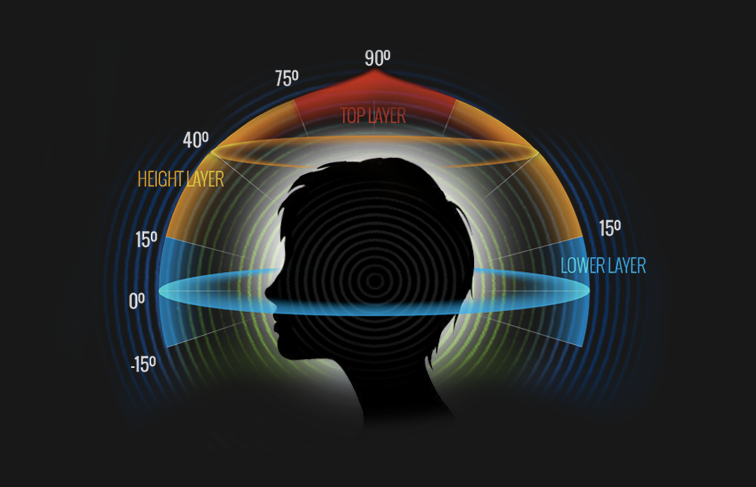
Immersive audio expands the sound field vertically. With technologies such as AURO-3D, sound can be reproduced not only around the listener but also above them, introducing height as an important part of the experience. The result can provide a greater sense of space, depth, ambience, and natural acoustic perspective.
In music, that might mean hearing the reflections and reverberation of a concert hall around and above you. In a movie, it could be environmental sounds that convincingly fill the three-dimensional space around the audience. In both cases, immersive audio gets closer to representing real life. And because the sound is more realistic, it can also more faithfully convey the emotion the artist or filmmaker intended you to feel.
However, the goal isn’t simply to hear more speakers. Ideally, it’s to become less aware of the speakers at all.

You Don’t Need a Dedicated Theater
A purpose-built immersive audio system with multiple loudspeakers provides the greatest opportunity to reproduce a complete three-dimensional sound field. But assuming that immersive audio requires such a system creates an unnecessary and costly barrier for consumers.
Think about video. You can watch the same movie on a smartphone, television, or enormous cinema screen. Those experiences clearly aren’t identical, but we don’t think of the movie itself as belonging exclusively to one of those displays.
Immersive audio is moving in a similar direction. The content can be created with an immersive listening experience in mind, while playback technology adapts that experience to the device available to the listener.
That means your first encounter with immersive music doesn’t necessarily have to happen in an elaborate listening room. It may very well be on a mobile phone with headphones.

Immersive Audio Through Headphones
Headphones might seem like an unlikely way to experience three-dimensional sound. After all, there are only two speakers, one in each ear.
The key is binaural rendering. Humans determine where sounds originate using remarkably subtle acoustic cues. A sound arriving from the side, behind us, or above us reaches each ear slightly differently. Our brains interpret differences in timing, level, frequency response, and other characteristics to determine where a sound appears to be located.
Binaural processing uses these principles to translate an immersive mix into a two-channel headphone signal while preserving spatial cues. Instead of everything existing directly between your ears, a proper binaural rendering can create the perception of sound that extends beyond the headphones, as if it were floating around your head.
For consumers, this is important because headphones are already one of the world’s most common ways to listen to music. So, the gateway to immersive music may already be sitting in your pocket or on your desk.

Soundbars Bring Immersion Into the Living Room
Soundbars represent another important step in making immersive audio more accessible.
Modern soundbars can combine multiple drivers, sophisticated digital signal processing, and acoustic techniques designed to create the perception of a much larger sound field than the physical enclosure might suggest.
Some systems use upward-firing or angled drivers. Others use reflections from walls and ceilings, virtualization, or combinations of physical and psychoacoustic techniques to expand the apparent listening space, such as Dynaudio’s Symphony Opus One.
A soundbar cannot physically reproduce a room filled with individually positioned loudspeakers. But that’s not really the point, is it? For many listeners, it can provide a sensational yet practical introduction to immersive entertainment without requiring a dedicated room or extensive installation.
Turn on the television, select immersive content, and sound reaches beyond the edges of the screen, drawing you into the on-screen action as if you were right there in the scene. Immersion simply becomes part of everyday viewing and listening.

Your Car Is an Immersive Listening Space
There is another environment particularly well suited to immersive audio: the automobile.
Cars already surround passengers with loudspeakers. Unlike a living room, the seating positions and speaker locations are known to the system designer. Modern vehicles can also incorporate speakers—sometimes more than 20 of them—in doors, pillars, dashboards, headliners, and other locations throughout the cabin. That makes the vehicle an excellent environment for creating a controlled, enveloping listening experience.
And the car matters for another reason: people spend a lot of time listening there!
For generations, automotive audio has helped introduce consumers to new listening technologies, from FM stereo to CDs, digital music, and streaming. Immersive audio has the potential to become another part of that evolution. A listener who experiences a favorite album in an immersive format during the morning commute may begin to expect that same sense of space when listening elsewhere.
The Experience Scales With the System
None of this means every immersive audio experience is identical. It isn’t and it just can’t be. A pair of headphones, a television, a soundbar, an automotive system, and a purpose-built AURO-3D listening room have very different physical capabilities.
A dedicated loudspeaker system can provide precise physical sound sources surrounding the listener. A soundbar may combine physical speakers with acoustic and processing techniques. Headphones depend on binaural reproduction to create spatial perception.
Each is a different window into the same broader idea and as playback systems become more capable, the experience can scale with them. That is one of the most important developments for the future of immersive audio.
Consumers don’t necessarily have to choose between experiencing immersive audio and not experiencing it. Instead, they can experience it at different levels and grow to expect it under all playback scenarios. And while the degree of immersion varies from system to system, the core benefit carries across all of them: a deeper emotional connection to the music, film, or game.

Music May Be Where the Difference Becomes Most Interesting
Movies and games are obvious applications for immersive sound. Explosions, weather, crowds, vehicles, and environmental effects naturally lend themselves to three-dimensional reproduction.
But music presents a different, and in some ways more subtle, opportunity. Immersive music doesn’t have to mean placing instruments dramatically above or behind the listener. It can be simply about reproducing a space.
Imagine a symphony recorded in a great concert hall. Part of what makes that performance feel real isn’t simply the orchestra in front of you. It’s the acoustic environment surrounding it: reflections from the side walls, reverberation from above, and the gradual decay of sound throughout the hall. Those spatial characteristics are part of the performance. And when they are faithfully reproduced, they make you feel as if you are in the room with the artist.
Immersive audio gives recording engineers additional dimensions with which to preserve and reproduce them. The result can be less about spectacular effects and more about creating the feeling that the walls of your listening room have disappeared and you are transported into the space the immersive audio has created for you.
Don’t Wait for the Perfect System
For years, immersive audio was often discussed primarily in terms of speaker configurations.
- How many speakers do I need?
- Where do they go?
- Do I need speakers in the ceiling?
- Do I need a dedicated room?
Those remain important questions when designing a high-performance system. But they shouldn’t determine whether someone begins exploring immersive audio at all. If you have compatible headphones, a soundbar, a television, an automotive audio system, or access to another immersive-capable device, you may already have a way to begin.
Then, as your playback system improves, the experience can grow with it.
That progression is familiar throughout consumer technology. We don’t wait until we own a professional cinema projector before watching movies. We don’t wait for reference studio monitors before listening to music.
Immersive audio shouldn’t be different!
Immersive Audio Is Becoming a Listening Format
The long-term significance of immersive audio isn’t simply that we can install more speakers in a room. It’s that artists, producers, engineers, technology companies, and manufacturers can increasingly think beyond two-channel playback when creating and delivering sound.
The room still matters. The playback system still matters. And for those seeking the highest level of performance, a properly designed multichannel loudspeaker system remains an extraordinary way to experience immersive content.
But the concept itself is much bigger than the room. From headphones on a morning walk to a soundbar in the living room, an audio system in the car, or a full AURO-3D home cinema, immersive sound can meet listeners where they already are.
Immersive audio is no longer defined by the room in which you experience it. It’s becoming part of how we experience sound itself.
And you can start listening NOW.
Author: Bert Van Daele (Principal Engineer Immersive Sound) Goer Dynamics B.V.